CLINICAL COMPENDIUM
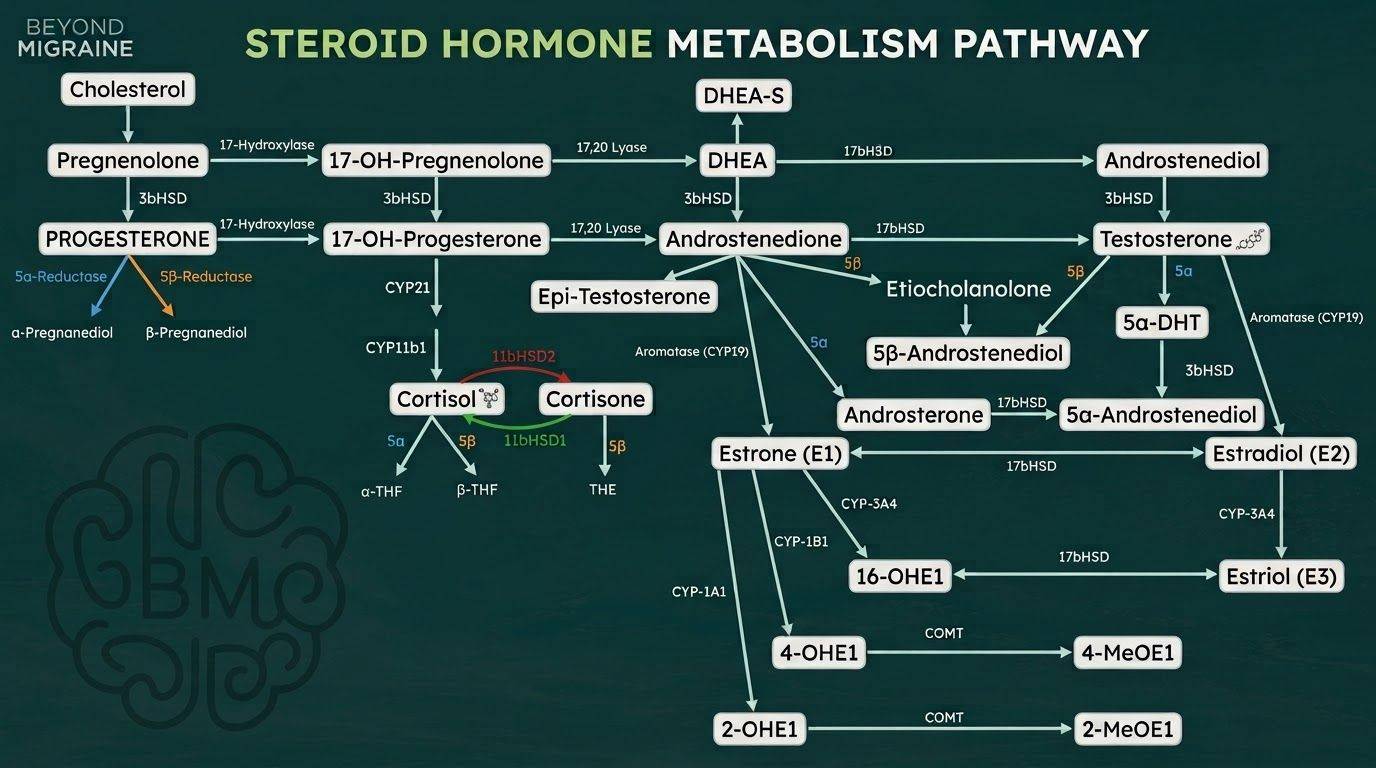
Steroid Hormone Cascade: Enzymatic & Nutraceutical Modulations
Peer-reviewed nutraceutical mechanisms, lifestyle triggers, and metabolic checkpoints across 5 cascade tiers.
9 Enzymes Indexed
| Enzyme & Tissue Site | Lifestyle Factors & Metabolic Triggers | Targeted Supplementation & Biochemical Mechanism |
|---|---|---|
|
Tier 1: Upstream Steroidogenesis & Delta5 to Delta4 Conversion
|
||
|
CYP17A1
17α-Hydroxylase / 17,20-Lyase
Adrenal Cortex & Gonads
Key gatekeeper shunting pregnenolone toward cortisol and sex steroids.
|
Upregulators / Inducers
Downregulators
|
Dihydrotanshinone (from Salvia miltiorrhiza / Danshen)
Acts as a potent, selective allosteric inhibitor of 17,20-lyase without disrupting 17α-hydroxylase or glucocorticoid flux, sharply mitigating hyperandrogenism.
Berberine HCl
Activates AMPK and enhances insulin receptor substrate-1 (IRS-1) signaling in ovarian theca cells, downregulating CYP17A1 gene transcription and reducing excessive testosterone/androstenedione output.
Inositol (Myo- & D-Chiro-Inositol in 40:1 Ratio)
Restores intracellular inositolphosphoglycan second messengers, reducing circulating insulin and suppressing excessive phosphorylation-induced 17,20-lyase hyperactivity.
Spearmint (Mentha spicata) & Licorice Root
Provide direct competitive active-site inhibition of ovarian CYP17A1, demonstrating anti-androgenic effects in clinical trials of hirsutism and PCOS.
Vitamin C & Niacin (NADPH Donor)
Function as essential electron donors through Cytochrome P450 Oxidoreductase (POR), maintaining physiological electron flow and preventing enzyme decoupling.
|
|
3β-HSD
3β-Hydroxysteroid Dehydrogenase / Δ5→Δ4-Isomerase
Adrenal Cortex & Gonads
Converts Δ5-steroids (Pregnenolone, DHEA) to Δ4-steroids (Progesterone, Androstenedione).
|
Suppressors / Impairers
Promoters
|
NAD+ Precursors (NMN / Nicotinamide Riboside)
NAD+ is the mandatory stoichiometric hydride acceptor in 3β-hydroxysteroid dehydrogenation; boosting cellular NAD+ optimizes reaction velocity.
Coenzyme Q10 (Ubiquinol 100–300 mg)
Protects the inner mitochondrial membrane and electron transport chain, preserving high ATP/NADH redox potential needed for continuous steroid isomerisation.
Guggulsterone (from Commiphora mukul)
Acts as an antagonistic ligand for farnesoid X receptors (FXR) and displays modulatory effects on steroidogenic enzymes, stabilizing steroid intermediate turnover.
Soy Isoflavones (Genistein & Daidzein)
Act as competitive, micromolar active-site inhibitors of 3β-HSD, moderating rapid androgen and progesterone formation in hyper-androgenic conditions.
|
|
Tier 2: Glucocorticoids & Cortisol Regulation
|
||
|
CYP21A2 & CYP11B1
21-Hydroxylase & 11β-Hydroxylase
Adrenal Zona Fasciculata
Terminal enzymatic chain converting 17-OH-progesterone to active Cortisol.
|
Upregulators / Inducers
Downregulators
|
Phosphatidylserine (PS) (400–800 mg)
Crosses the blood-brain barrier to blunt acute hypothalamic CRH and pituitary ACTH hyper-secretion induced by physical or mental stress, directly reducing enzyme induction.
Rhodiola rosea (Salidrosides & Rosavins)
Modulates neuropeptide Y and downregulates stress-induced ACTH and cortisol surges, preventing adrenal cortical hypertrophy and sustained CYP21/CYP11B1 hyperactivity.
Ashwagandha (Withania somnifera - Withanolides)
Exerts central GABA-mimetic calming actions that attenuate pituitary ACTH release and downregulate adrenal hydroxylase transcription in chronic stress states.
Cordyceps sinensis
Acts as a bidirectional endocrine adaptogen; dampens excessive stress-induced adrenal output while providing mitochondrial protection under hypoxic or intense physical stress.
Ascorbic Acid (Vitamin C) & Pantothenic Acid (B5)
The adrenal cortex maintains the highest ascorbate concentration in the body to protect the iron-sulfur clusters of CYP11B1 from oxidative inactivation during electron transfer.
|
|
11β-HSD1 & 11β-HSD2
11β-Hydroxysteroid Dehydrogenase Types 1 & 2
Adipose, Liver, Brain & Kidney
Tissue-level gatekeeper: Type 1 reactivates cortisone → cortisol; Type 2 inactivates cortisol → cortisone.
|
11β-HSD1 Upregulators (Tissue Hypercortisolemia)
11β-HSD2 Disruptors (Loss of Renal Protection)
|
Emodin (from Rheum palmatum & Polygonum cuspidatum)
A nanomolar-affinity, selective non-competitive inhibitor of 11β-HSD1; prevents inactive cortisone from turning into active cortisol in visceral adipose and liver tissue, mitigating metabolic syndrome.
Eriobotrya japonica (Loquat Leaf) & Corosolic Acid
Triterpenes selectively inhibit adipose 11β-HSD1, improving peripheral insulin sensitivity and blunting glucocorticoid-driven hepatic gluconeogenesis.
EGCG, Curcumin, & Resveratrol
Directly inhibit the dehydrogenase/reductase pocket of 11β-HSD1, reducing local active cortisol regeneration in metabolic tissues.
Glycyrrhetinic Acid / Carbenoxolone (from Licorice Root)
Potently blocks 11β-HSD2 in the kidney, preventing cortisol from converting into inert cortisone to prolong systemic cortisol half-life (therapeutic in hypocortisolemia; contraindicated in hypertension).
|
|
Tier 3: Androgens & Progesterone Metabolism
|
||
|
17β-HSD
17β-Hydroxysteroid Dehydrogenase (Types 1–5)
Gonadal & Peripheral Target Tissues
Bidirectional terminal switch: Androstenedione ↔ Testosterone; Estrone ↔ Estradiol.
|
Disruptors / Pathological Drivers
Promoters
|
Zinc (Bisglycinate / Picolinate 25–45 mg)
Essential structural co-factor for testicular 17β-HSD type 3; required for the reduction of androstenedione to bioavailable testosterone in Leydig cells.
Curcumin (Curcuma longa)
Demonstrated in biochemical assays to modulate and selectively inhibit 17β-HSD type 3, blunting excessive testicular and peripheral testosterone pooling in hyperandrogenic states.
Luteolin, Quercetin, & Apigenin
Natural flavones that selectively inhibit 17β-HSD Type 1, preventing peripheral conversion of estrone (E1) into proliferative 17β-estradiol (E2) in breast tissue.
|
|
5α-Reductase
5α-Reductase Types 1 & 2 (SRD5A)
Prostate, Hair Follicles & Sebaceous Glands
Reduces Testosterone into 5α-DHT (3–5x more potent) and Progesterone to 5α-DHP.
|
5α-Pathway Inducers (Androgenic Potency)
Favourable Modulators
|
Pumpkin Seed Oil (Δ7-Sterols) & β-Sitosterol
Contains specific phytosterols that competitively inhibit both type 1 and type 2 5α-reductases, clinically validated to improve hair count and prostate health.
Saw Palmetto (Serenoa repens) & Pygeum africanum
Liposterolic extract blocks conversion of testosterone into DHT and impedes DHT from binding nuclear androgen receptors.
Reishi Mushroom (Ganoderma lucidum - Ganoderic Acids)
Triterpenoids exert high inhibitory capacity against 5α-reductase in target follicular and prostatic cells.
Stinging Nettle Root (Urtica dioica) & Zinc
Inhibits 5α-reductase while also competitively binding Sex Hormone-Binding Globulin (SHBG), optimizing the free/bound hormone balance.
EGCG, Quercetin, & Curcumin
Synergistic polyphenol combination that provides lipid-soluble competitive inhibition across both 5α-reductase isoforms.
|
|
Tier 4: Aromatase & Estrogen Synthesis
|
||
|
CYP19A1
Aromatase (Estrogen Synthetase)
Adipose Stromal Cells, Ovaries & Brain
Converts Androstenedione → Estrone (E1) and Testosterone → Estradiol (E2).
|
Upregulators / Inducers
Downregulators
|
Chrysin (with Piperine) & Apigenin
Potent bioflavonoids that fit into the substrate-binding cleft of CYP19A1, providing competitive inhibition of aromatization (piperine overcomes poor baseline bioavailability).
Grape Seed Extract (Proanthocyanidins)
Dose-dependently inhibits aromatase enzyme activity and suppresses promoter I.3 and II transcription in adipose and breast fibroblasts.
White Button Mushroom (Agaricus bisporus - CLA & Phytochemicals)
Contains conjugated linoleic acid (CLA) isomers and lectins that act as non-competitive irreversible inhibitors of aromatase.
Damiana (Turnera diffusa - Acacetin & Pinocembrin)
Pinocembrin and acacetin isolated from Damiana significantly suppress aromatase activity in human placental microsomes.
Hesperidin, Resveratrol, & Zinc
Citrus bioflavonoids and zinc alter active-site electron spin states, moderating aromatase velocity.
Omega-3 Fatty Acids (EPA/DHA 2–4 g)
Suppresses COX-2 and PGE2 synthesis, closing off the primary inflammatory promoter driving CYP19A1 gene transcription.
|
|
Tier 5: Estrogen Clearance (Phase I Hydroxylation & Phase II Conjugation)
|
||
|
CYP1A1, CYP1B1, CYP3A4
Phase I Estrogen Hydroxylases
Hepatic & Peripheral Phase I
Branches E1 & E2 into 2-OH (protective), 4-OH (genotoxic/reactive), or 16α-OH (proliferative).
|
CYP1B1 Upregulators (Genotoxic Pathway)
CYP1A1 Inducers (Protective Pathway)
|
Sulforaphane (from Broccoli Seed Extract)
Potent Keap1-Nrf2 activator; downregulates AhR-mediated CYP1B1 expression while upregulating protective Phase II enzymes (NQO1, GSTP1) to prevent catechol estrogen quinone formation.
Diindolylmethane (DIM) & Indole-3-Carbinol (I3C)
Potently induces CYP1A1 transcription, significantly shifting the urinary 2-OHE1:16α-OHE1 ratio in favour of the benign, anti-proliferative 2-hydroxy metabolite.
Resveratrol, Quercetin, & Naringenin
Directly bind and inhibit the heme-thiolate catalytic pocket of CYP1B1, suppressing toxic 4-OHE1 generation.
Rosemary Extract (Carnosic Acid & Rosmarinic Acid)
Stimulates liver Phase I hydroxylation towards 2-OHE1 and protects hepatic microsomes against oxidative lipid peroxidation.
Calcium D-Glucarate
Inhibits bacterial β-glucuronidase in the gut lumen, preventing conjugated estrogen metabolites from de-conjugating and being reabsorbed into systemic circulation (essential downstream clearance support).
|
|
COMT
Catechol-O-Methyltransferase
Hepatic, Renal & CNS Phase II
Converts 2-OHE1 → 2-MeOE1 and 4-OHE1 → 4-MeOE1 to prevent cancer-causing quinones.
|
Competitive Inhibitors & Depletors
Promoters
|
Magnesium (Glycinate / Malate / Threonate)
Mandatory divalent cation co-factor; binds to the active site to coordinate catechol hydroxyl oxygens and enable the transfer of methyl groups from SAMe.
S-Adenosylmethionine (SAMe), L-5-MTHF, Methyl-B12, P5P (B6)
Direct methyl donors and cycle intermediates that replenish S-adenosylmethionine to maintain a high SAMe/SAH ratio required for uninterrupted transmethylation.
Trimethylglycine (TMG / Betaine) & Choline
Fuels the alternate BHMT (betaine-homocysteine methyltransferase) pathway in the liver, sparing methionine and preserving systemic SAMe generation.
Creatine Monohydrate (3–5 g)
Endogenous creatine synthesis consumes >40% of all SAMe methyl groups; oral creatine supplementation dramatically spares methyl donors for COMT estrogen detox.
N-Acetyl Cysteine (NAC)
Replenishes intracellular glutathione pools to conjugate and eliminate depurinating 3,4-quinone intermediates that escape Phase II COMT methylation.
Clinical Warning: Competitive COMT Inhibition
High doses of catechol-containing polyphenols (Quercetin, Fisetin, EGCG/Green Tea, Pyrogallol) act as direct competitive substrates for COMT. In patients with the COMT Met/Met (slow) genotype or high anxiety, high supplemental doses will paradoxically stall catechol estrogen methylation and elevate catecholamines.
|
No matching enzymes, herbs, or compounds found
Check spelling or reset pathway filters.
Upregulators & Disruptors
Physiological Promoters & Inhibitors
Substrate Warning / Caution
Endocrine Biochemistry Clinical Matrix